

Legends & History: Red Rum, Three Grand Nationals and the Making of a Racing Icon
 |
|


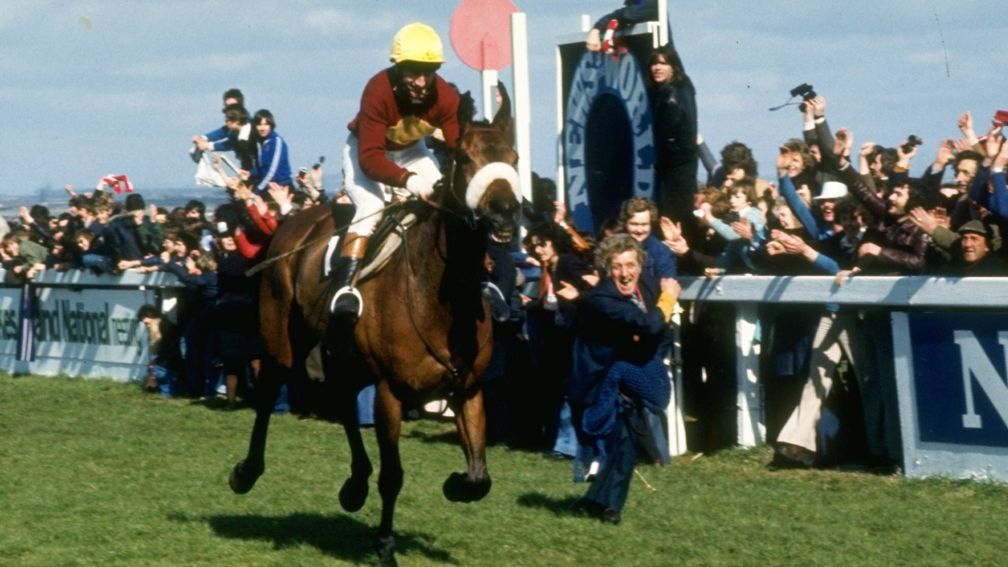
The Aintree Grand National is a race that resists prediction and defies the form book. It is run over 4 miles 514 yards, across 30 fences, in a field of up to 40 horses, with handicap weights designed to give every runner a theoretical chance. No horse in history has beaten those odds three times, except Red Rum.
From Obscurity to Aintree
Red Rum was foaled in 1965 and raced as a two-year-old on the flat, winning on the same day as a dead heat at Aintree, a detail that acquires retrospective significance. He spent his early career in moderate flat and jump company and seemed destined for an unremarkable career. He changed hands several times. By 1972, he was bought for 6,000 guineas at Doncaster Sales by trainer Donald “Ginger” McCain, a used car dealer from Southport who trained his small string of horses on the beach at Southport Sands, using the tide and the salt water as a natural swimming pool for leg conditioning. McCain had noticed that Red Rum’s chronic pedal osteitis, a bone condition that caused persistent lameness, improved dramatically in the wet sand environment.
The transformation was remarkable. A horse that had shown moderate ability suddenly began thriving under conditions that suited his specific physical requirements. By early 1973, Red Rum was ready for what would become his destiny.
1973: The First National
The 1973 Grand National produced one of the race’s greatest finishes. Crisp, an Australian chaser trained by Fred Winter, led the field for almost the entire race, jumping boldly and establishing what appeared an unassailable lead approaching the final fence. He led by thirty lengths at the last. Red Rum, ridden by Brian Fletcher, caught him in the final strides and won by three-quarters of a length in a new course record time that stood for decades.
The story should have ended there: a good horse winning an extraordinary race in extraordinary circumstances. Instead, it was only the beginning.
1974: Back-to-Back
Red Rum returned to Aintree in 1974 and won again. In a field of 42 runners, he defeated L’Escargot by seven lengths in what was a more commanding performance than the previous year’s squeaker against Crisp. Two consecutive Grand National wins were remarkable; only a handful of horses had achieved back-to-back victories in the race’s history.
The next two years brought finishing positions of second, in 1975 behind L’Escargot (who had his revenge) and in 1976 behind Rag Trade. Red Rum was running in every renewal not just to compete but to fight for the win; his second-place finishes in those years were achieved against horses receiving weight allowances in a handicap race that by rights should have been beyond any single horse to dominate.
1977: The Hat-Trick
At the age of twelve, in what would be his final Grand National start, Red Rum won for the third time. He was sent off as the 9/1 favourite, extraordinary odds for a twelve-year-old in the National and won by twenty-five lengths from Churchtown Boy. Brian Fletcher had given way to Tommy Stack as his jockey; the partnership was new, but the outcome was the same.
No horse has won three Grand Nationals before or since. Red Rum finished second twice in the years between his victories, giving him a record of five consecutive National runs at Aintree yielding 3-2-2 (and a sixth run before those). As a Grand National racehorse, he was simply without parallel.
Life After Racing
Red Rum was retired after his 1977 triumph and became one of the most celebrated racehorses in British history. He appeared at the Grand National as a celebrity horse for years after his retirement, parading before the race, drawing enormous crowds and competing attention with the actual running of the event. He was stabled at Ginger McCain’s yard in Southport until his death on 18 October 1995, aged 30, from colic. He was buried at the Aintree winning post, the only horse to be buried at the track where he became a legend.
His legacy extends beyond racing statistics. Red Rum’s three Grand National victories, the first in 1973, the third in 1977, span a period when the race itself was in its most commercially uncertain phase, before major sponsorship transformed it into the global phenomenon it is today. His character, and the narrative of his training on Southport beach, gave the race a human story that captured audiences who had never watched horse racing. He helped make the Grand National what it is today.
For the 2026 Grand National (11 April, Aintree), Red Rum’s record will provide its usual context. The field will include horses carrying his legend into their calculations, knowing that the race he won three times is one of the most difficult sporting challenges in the world.


