

Equine Welfare: Four Horses Die at Cheltenham Festival 2026, RSPCA Demands Urgent Action
 |
|


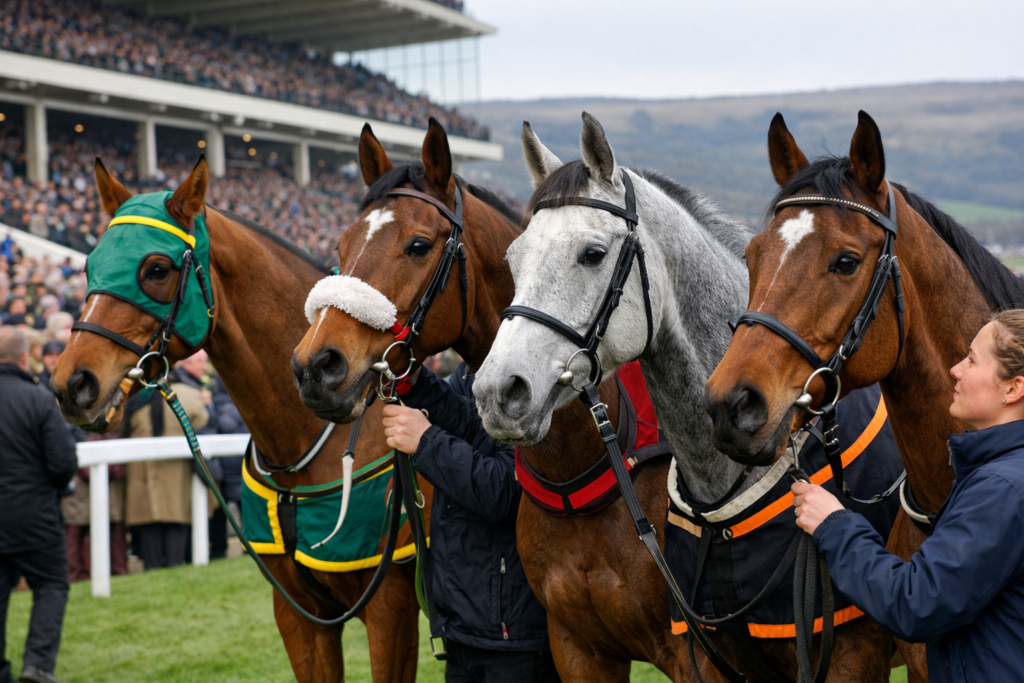
Four horses died across the four days of the 2026 Cheltenham Festival, triggering a formal welfare response from the RSPCA and renewed scrutiny of equine safety measures at National Hunt racing’s premier meeting.
The Four Fatalities
Hansard suffered a fatal injury after being pulled up in the Singer Arkle Challenge Trophy Novices’ Chase on Tuesday 10 March, Champion Day. He became the twentieth horse to lose its life in competitive UK racing in 2026.
HMS Seahorse died following a fall in the BetMGM Cup Handicap Hurdle on Wednesday 11 March, Ladies’ Day. His death brought the 2026 UK racing fatality count to 21 horses.
Envoi Allen, a twelve-year-old bay gelding, collapsed and died after safely completing the Boodles Cheltenham Gold Cup on Friday 13 March. He had been planned to retire following the race, his eighth and final Festival appearance. The twelve-year-old had won ten Grade 1 races across his career, beginning under trainer Gordon Elliott before moving to Henry de Bromhead. He had become the first horse to win the Down Royal Champion Chase three times and was given a rousing reception by the Cheltenham crowd as he entered the parade ring before the Gold Cup. His connections had announced his retirement before the race. His death prompted an immediate and emotional response from Henry de Bromhead’s yard, with the trainer describing him as “an incredible servant.”
Saint Le Fort suffered a fatal fall in the Martin Pipe Conditional Jockeys’ Handicap Hurdle, the final race on Gold Cup Day, dying from a fatal injury at the last flight. His death brought the Festival’s total to four fatalities across the four days and the UK’s 2026 competitive racing total to 24 horses.
The RSPCA’s Response
The RSPCA released a formal statement following the Festival’s conclusion, expressing deep concern at the week’s toll and calling for urgent industry action:
“We are deeply saddened that four horses died at the Cheltenham Festival this year. The deaths of Hansard, HMS Seahorse, Envoi Allen and Saint Le Fort mean 24 horses have lost their lives in competitive racing in the UK this year alone.”
The charity described the fatalities as “clearly at odds with the UK’s status as a nation of animal lovers” and stated that the scale of deaths “reiterate the urgency that lessons must be learned, including what caused the loss of life, decision making during the race, and any future means of prevention.”
The RSPCA also noted its commercial context: “Many of these events, like Cheltenham, and the Grand National, are massive economic drivers, and watched by hundreds of thousands of people. The very least the horses competing deserve in return is to have every possible step taken to improve their safety and welfare.”
The charity confirmed it had received assurances from the BHA that welfare remains a priority and pledged to continue engaging with the racing industry to advocate for further safety measures.
The BHA’s Position
James Given, the British Horseracing Authority’s director of equine regulation safety and welfare, issued a statement on Friday evening describing the deaths as devastating:
“We are all devastated about the fatal injuries this week and our thoughts are with everyone connected with the horses. All runners at the Festival are provided with an extensive and thorough check by vets at the racecourse before competing.
“As a result of British racing’s commitment to reducing avoidable risk, the fatal injury rate has reduced to fewer than five in every 1,000 runners. The fatality rate at Cheltenham Racecourse in the past five years is exactly in line with this.
“However, we never just accept these injury rates. As with any fatal injury, these incidents will now be looked at in detail through our fatality review process, which is part of the sport’s commitment to ongoing improvements in racehorse safety. Risk can never be entirely eliminated. British racing is transparent about the risks involved in the sport and publishes data regarding injury rates on its website at HorsePWR.co.uk.”
Context: Fatality Rates in British Racing
The BHA’s published fatality rate, fewer than five in every 1,000 runners, is the benchmark against which individual meetings are assessed. Four deaths across a Festival that attracted approximately 200+ starts across 28 races is statistically consistent with the sport’s published rate, though that statistical frame provides limited comfort to those directly affected.
The Cheltenham Festival’s unique profile, 28 races, the highest concentration of Grade 1 jump racing anywhere in the world, often over fences in conditions that test every horse’s stamina and jumping accuracy, creates a week in which fatality risk is compressed into a short public window. The visibility of Cheltenham’s fatalities is therefore higher than for equivalent numbers spread across a season of lower-profile meetings.
Critics, including the RSPCA, argue that the existing rate remains unacceptably high regardless of its statistical consistency. Campaigners have called for stricter pre-race withdrawal decisions for horses showing signs of fatigue, improved course design to reduce the risk of falls, and limits on the number of races horses run in a season. The BHA maintains that continuous improvement is ongoing and that the fatality rate has reduced over the period during which it has been systematically tracked and published.
Envoi Allen: A Special Footnote
For many involved in racing, Envoi Allen’s death carried particular weight. He was not a casualty of a fall or a race-day accident in the conventional sense, he completed the Gold Cup, finished ninth, and collapsed in the immediate aftermath, a consequence of acute cardiac or circulatory failure. The twelve-year-old had given connections a decade of service across 25 career starts, winning ten Grade 1 races. His owner, Cheveley Park Stud, had confirmed his retirement before the race; he was to be retired to their stud following his final Festival run.
The circumstance of a horse dying after completing a race safely, having navigated 22 fences and three miles, underscores the fundamental unpredictability of equine physiology under the extreme demands of championship racing, and is distinct from preventable falls or injuries caused by course conditions.


