

Legends & History: Frankel, Fourteen Races, Fourteen Wins, the Highest Rating Ever Given
 |
|


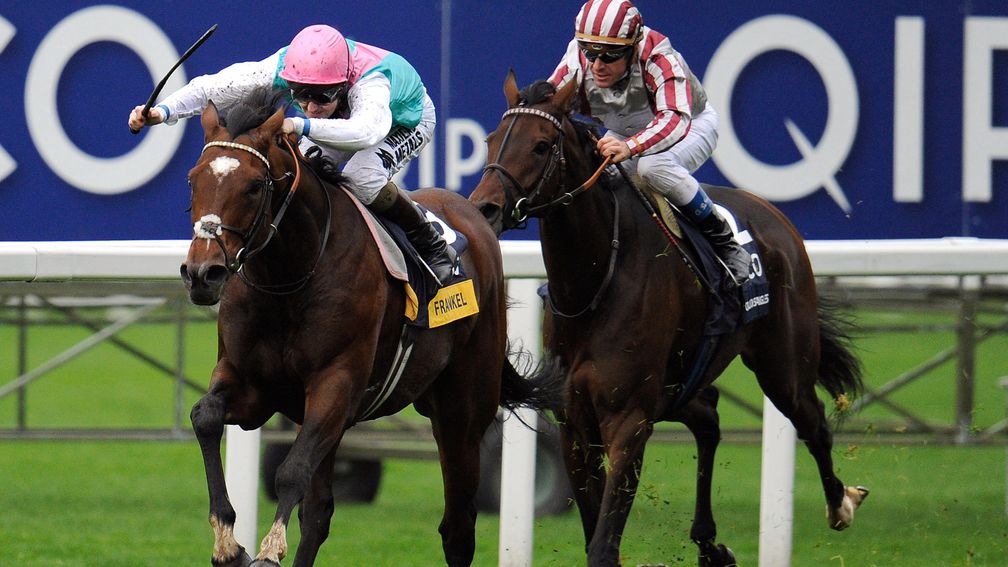
Timeform assigns ratings to racehorses on a scale that attempts to quantify their ability relative to their contemporaries and to historical standards. No horse in the organisation’s history (founded in 1948), has ever received a rating as high as the 147 awarded to Frankel following his racing career. For context, most champion horses receive ratings in the 120 – 135 range. Frankel was not merely the best horse of his generation; in the formal measurement system used by the sport, he was the best horse that has ever run.
Breeding and Early Life
Frankel was bred by Prince Khalid Abdullah, whose Juddmonte Farms operation is one of the most respected breeding enterprises in the world. His sire was Galileo, himself a champion racehorse and subsequently the most influential sire in European racing history. His dam was Kind, a multiple Group winner. The combination produced a chestnut colt of unusual physical scope, tall, rangy, with the kind of stride that, in the words of his trainer Sir Henry Cecil, “covered the ground like no horse I have ever trained.”
Cecil, who trained from Warren Place stables in Newmarket, was already one of the most celebrated trainers in British racing history when Frankel arrived in his yard. His 25 British Classic victories and multiple champion trainer titles were established over more than four decades. Frankel was to be the defining chapter of a legendary career.
The Career
Frankel raced 14 times between August 2010 and October 2012. He was unbeaten. His victories included:
– **2,000 Guineas (2011):** His first Classic, at Newmarket, won by six lengths from Excelebration in a performance that left the racing world struggling for adequate language. Tom Queally, his jockey, used the whip only once, in the final furlong, to maintain concentration rather than effort.
– **St James’s Palace Stakes (2011):** Another Group 1 at Royal Ascot over the straight mile.
– **Queen Anne Stakes (2012):** At Royal Ascot, over a mile, opening his four-year-old campaign.
– **Queen Elizabeth II Stakes (2012):** At Ascot in October, his penultimate race.
– **Champion Stakes (2012):** His final race, stepped up to 1 mile 1 furlong at Ascot, a distance question that occupied discussion throughout the year. He won it, demonstrating that the speed that had characterised his mile performances was married to genuine stamina.
Beyond his Flat wins, Frankel won 10 Group 1 races across his career. He won over trips from 7 furlongs to 1+ miles. He was never headed in a race and never extended to anything approaching his maximum. His post-race physiology was so undemanding that Cecil regularly noted he came back from major races “barely blowing.”
The Guineas Performance
His 2,000 Guineas victory is the race most frequently cited when Frankel’s name is invoked. The start was poor, he burst from the stalls almost uncontrollably and blazed to the front at a pace that should, by conventional wisdom, have led to a dramatic collapse in the final furlong. Instead, six lengths ahead of a world-class field at the winning post and untouched, Frankel made the case that conventional wisdom did not apply to him.
Queally’s skill throughout the ride was considerable, allowing the horse to use his natural exuberance without fighting him, but the performance was Frankel’s. No horse who had previously raced in the Guineas had produced a display of that magnitude.
Legacy and Stud Career
Sir Henry Cecil died in June 2013, shortly after Frankel’s retirement. He did not live to see the full flowering of Frankel’s impact at stud, but the foundations were already clear. Frankel has become one of the most influential sires in the world. His progeny have won Group 1 races across multiple continents and disciplines. At Juddmonte’s Banstead Manor Stud in Newmarket, he has become the farm’s most valuable asset, his covering fee has been reported among the highest in Europe.
For British racing, Frankel’s legacy is permanent. His statue at Newmarket, and the continued reference to his rating and career record whenever a potentially exceptional horse emerges, means his presence is as real in 2026 as it was in 2012. Every time a young Frankel offspring wins a Group race, the comparison begins, and the bar it invites comparison to remain impossibly high.


