

Photo Finish Technology: How Milliseconds Became Measurable
 |
|


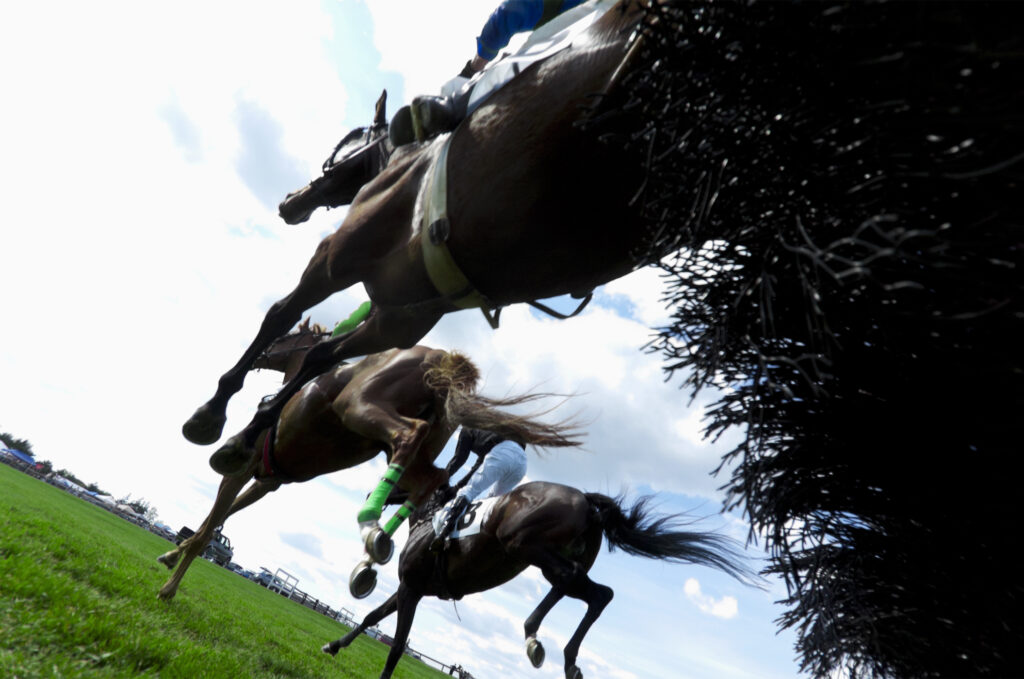
The photo finish camera revolutionised horse racing by replacing human judgment with objective mechanical evidence. Before its introduction in the 1930s and widespread adoption in the 1940s-1950s, close finishes were decided by race judges whose naked-eye assessments were final and sometimes controversial. The photo finish camera didn’t just resolve disputes it redefined what “winning” meant by making margins measurable to fractions of inches.
How It Works
Unlike conventional cameras that capture an entire scene in a single exposure, photo finish cameras use a narrow vertical slit sensor positioned exactly at the finish line. The sensor captures a continuous strip image as horses cross the line, with time running horizontally across the image rather than being frozen in a single moment.
This creates a distorted but accurate image: horses that cross the line first appear compressed and ahead; those crossing later appear stretched and behind. The system is insensitive to lens angle or perspective, only the order in which horses’ noses cross the plane of the finish line matters.
Modern digital photo finish systems capture images at rates exceeding 1,000 frames per second, allowing margins to be measured to thousandths of a second or millimetres of distance. The Hawk-Eye system, adopted at many British racecourses including Ascot and Newmarket, uses multiple cameras to provide redundancy and different viewing angles.
Dead Heats and Margins
The photo finish system revealed that true dead heats, horses crossing the line at exactly the same moment, are extraordinarily rare. Most “dead heats” declared are actually ties for practical purposes where the margin is too small to call reliably, typically less than 1cm.
Official margins in British racing are recorded as: short head, head, neck, half a length, quarter length, 1 length, and so forth. These descriptions attempt to translate precise photographic evidence into language comprehensible to viewers. But the underlying photo provides objective truth: one horse’s nose crossed the line before the others, or they crossed simultaneously.
The Historical Impact
The introduction of photo finish technology removed a major source of controversy from racing. Before cameras, disputed finishes could generate legal challenges, accusations of bias, and public mistrust. After cameras, the result was simply what the photograph showed.
This shift had subtle but important consequences: it made racing more credible as a betting medium, because punters could trust that results were determined by objective evidence rather than subjective judgment. It also raised the stakes for jockeys, who could no longer rely on judges’ inability to distinguish tiny margins, every inch now mattered.
Modern Developments
Current photo finish systems integrate with timing systems, GPS tracking, and in-running data to provide comprehensive race information. The British Horseracing Authority’s photo finish database archives every finish since digital systems were introduced, creating a historical record that earlier generations lacked.
Some modern systems can detect false starts by tracking horses’ positions before the starting gate opens. Others integrate with doping control systems to flag horses for testing based on unusual performance patterns revealed through finish-line analysis.
The technology that seemed revolutionary in the 1930s is now so routine that spectators rarely think about it. But its impact remains: racing is a sport where thousandths of a second determine winners and losers, and the photo finish camera is what makes that precision possible.


